
Imagine you’re about to execute a complex cross-chain DeFi trade from a browser on a US workstation: a leveraged swap, a liquidity move, or a multi-step zap that touches two networks. The stakes are not academic — a mis-signed approval or a hidden fee can cost real dollars. That concrete scenario is why Rabby Wallet’s combination of transaction simulation, multi-chain coverage, and security tooling matters. This article walks through how to get Rabby on the platforms you use, how its key mechanisms change the signing decision, where it still falls short, and how to choose between it and more familiar wallets like MetaMask when you need precision and safety.
I’ll assume you know basic wallet hygiene (never share seed phrases, use hardware wallets for large holdings). The goal here is to translate Rabby’s technical features into decision rules you can use when setting up, transacting, or auditing a DeFi session on Chromium browsers, mobile, or desktop environments in the United States.
Where to download and how to install (browser, desktop, mobile)
Rabby is available across three common touchpoints: a browser extension for Chromium-based browsers (Chrome, Brave, Edge), a desktop app for Windows and macOS, and mobile clients for iOS and Android. For power users who spend most of their DeFi time in browser-based dApps, the extension is the usual starting point. To fetch the official distribution and installation instructions, consult the project’s site and verified store pages; for convenience and a succinct walkthrough, see this page for Rabby’s official resources: rabby.
Installation checklist (practical):
- On desktop browsers, install from the web store for your Chromium browser, then pin the extension. After installation, create or import a wallet (seed phrase/private key) following the UI. Consider enabling the ‘Flip’ toggle if you want Rabby and MetaMask to coexist as switchable defaults.
- For hardware-backed security, pair Rabby with a supported device (Ledger, Trezor, Keystone, etc.) during setup. This is not optional for institutional or high-value personal accounts — hardware wallets keep private keys off the host machine.
- Desktop clients follow a similar flow: download the signed binary for Windows or macOS and connect your existing wallet or create a new profile. Mobile installs proceed from the App Store or Google Play with the same import/creation steps.
One practical note: US users should verify the extension’s publisher and checksum when possible. Browser store listings can be imitated; make sure the install source is genuine. Using hardware wallet integration requires an extra step of USB/Bluetooth pairing and verifying transaction details on the device itself.
How Rabby works: transaction simulation, risk scanning, and network switching
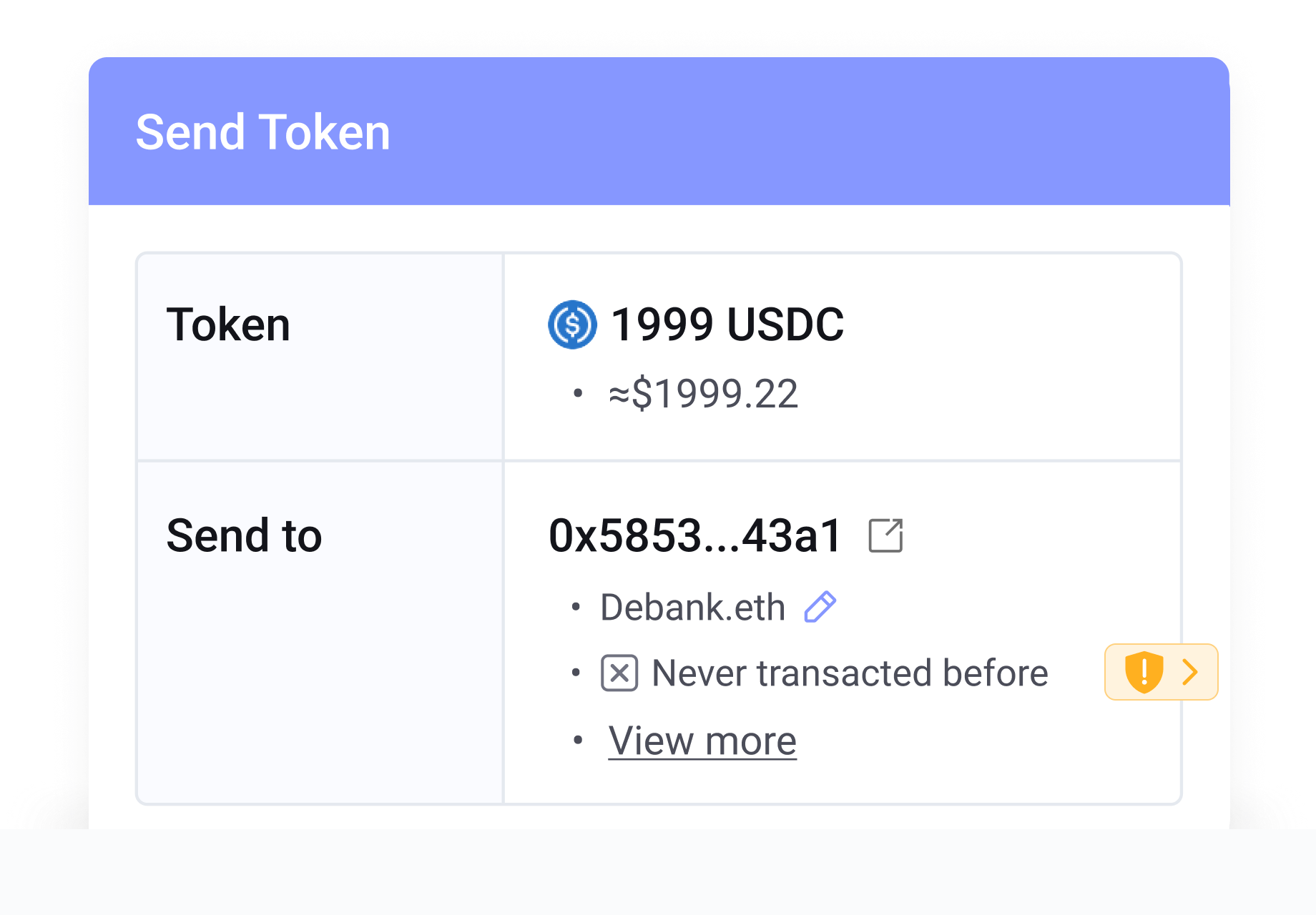
Rabby’s defining functional difference compared with many popular EVM wallets is its emphasis on pre-transaction analysis. Before you sign, Rabby simulates the transaction and displays estimated token balance changes and fee costs. This is more than a cosmetic confirmation screen: simulation exposes the exact state changes a transaction would produce under current chain state. For DeFi power users who routinely batch calls or interact with composable contracts, that simulation reduces the risk of ‘blind signing’ where the UI’s description diverges from the actual contract calls.
Complementing simulation is Rabby’s built-in security engine. It screens transactions for known risk signals — interactions with previously exploited contracts, suspicious approval patterns, or recipients that don’t exist on-chain. Think of it as a checklist-based filter: it doesn’t guarantee safety, but it flags typical red flags and gives you an explicit reason to pause and investigate.
Automatic network switching is another operational convenience. When you open a dApp that lives on Arbitrum or Optimism, Rabby can detect the required chain and switch for you. This reduces user error from forgetting to change networks before signing, a common source of failed transactions and accidental slippage. The trade-off is subtle: while automatic switching lowers friction, it also increases the importance of the wallet’s UI clarity — you must still confirm you’re operating on the intended chain, especially when bridging assets across networks.
Trade-offs, limitations, and past incidents you should weigh
No tool is unambiguously superior in all scenarios. Rabby is open-source (MIT), which invites independent audits and community scrutiny — a structural plus for security-minded users. It supports over 90 EVM chains, integrates with multi-sig and enterprise custody solutions (Gnosis Safe, Fireblocks), and offers convenient features like cross-chain gas top-up and approval revocation. Those capabilities make it attractive for multi-chain traders and teams.
But there are concrete limitations and historical cautions. Rabby does not provide a native fiat on-ramp; you can’t buy crypto with a debit card inside the wallet UI. It also lacks native staking features — if your workflow depends on staking within the wallet interface, you will still need other interfaces. Architecturally, being open-source reduces opacity but doesn’t eliminate bugs; in 2022 an associated Rabby Swap smart contract was exploited for roughly $190,000. The team froze the contract, reimbursed users, and tightened audits — a responsible response — but the event is a reminder that even security-focused projects can suffer supply-chain or contract-level failures.
Another trade-off concerns ecosystem integration: Rabby’s simulation and risk scanning are powerful when they catch common exploit patterns, but they are deterministic filters built on known signals. Novel or subtle exploits can still slip through if they do not match the detection heuristics. In short: Rabby’s tooling reduces, but does not eliminate, the need for vigilance and external checks.
How to evaluate Rabby against alternatives (MetaMask, Trust, Coinbase)
When choosing a wallet, match features to your primary failure modes. If your biggest risk is blind signing and interacting with complex DeFi contracts, Rabby’s transaction simulation and approval-revocation tools are decision-useful. If your priority is fiat on-ramp convenience or integrated staking, other wallets may be more suitable because Rabby lacks those native features.
Hardware compatibility is a differentiator: Rabby supports a wide set of devices (Ledger, Trezor, Keystone, etc.), which narrows the security gap to custodial or exchange wallets. For institutional or multi-user workflows, Rabby’s integrations with Gnosis Safe and enterprise custody providers make it a practical candidate. But if you prioritize the broadest possible consumer integration (on-ramps, custodial backup), a custodial wallet or exchange-linked product may still be preferable for non-power users.
Practical heuristics for DeFi sessions using Rabby
Here are re-usable rules of thumb based on Rabby’s mechanisms and limits:
- Before signing any multi-call transaction, always read the simulation pane. If the simulated balance changes don’t match the intended action, stop and break the transaction into smaller steps.
- Use hardware wallets for any account holding significant capital; Rabby’s simulations should complement, not replace, device-level verification of transaction content.
- Run approval revocation audits monthly for active addresses. Approval creep is a common post-hack vector; revoking unused permissions materially reduces exposure.
- When bridging or cross-chain trading, fund gas on the destination chain using the gas top-up feature rather than sending tokenized gas ad hoc — it reduces the risk of stranded assets and failed flows.
- For institutional or team operations, favor Rabby’s multi-sig integrations and require multiple device confirmations for high-value transfers.
What to watch next: signals that would change Rabby’s risk/benefit profile
Monitor three kinds of signals: product extensions, security audits, and ecosystem integrations. A verified fiat on-ramp addition would broaden Rabby’s appeal to retail users; a native staking module would change its competitive position relative to wallets offering integrated yield. Technically, stronger formal verification of its simulation engine or publication of third-party audits that demonstrate low false-negative rates in risk scanning would increase trust for high-risk DeFi use cases. Conversely, any recurrence of contract-level exploits or a pattern of unforced errors in release management would raise caution flags for large-value users despite Rabby’s open-source nature.
FAQ
How does Rabby’s transaction simulation improve security in practice?
Simulation reveals the exact state changes and token movements a transaction will produce before you sign. In practice this prevents common blind-signing mistakes — for example, approving a token spending limit far larger than intended or executing a multi-call route that drains funds via an unexpected swap path. It doesn’t replace other protections (hardware wallets, code audits), but it changes the default risk posture from blind trust to informed consent.
Can Rabby replace a hardware wallet or custody solution?
No. Rabby is non-custodial software that supports hardware devices and custody integrations; for any high-value or institutional account, you should pair Rabby with a hardware wallet or an enterprise custody service. Rabby’s integrations (Ledger, Trezor, Gnosis Safe, Fireblocks) are designed to make that pairing practical and safer than using a hot wallet alone.
Does Rabby support all EVM chains and tokens I might need?
Rabby supports over 90 EVM-compatible chains, including major networks like Ethereum, BNB Chain, Arbitrum, Optimism, Polygon, and Avalanche. That covers most DeFi activity, but if you rely on non-EVM chains or niche layer-2s not listed, you should confirm support before assuming compatibility.
What are the most common misperceptions about Rabby?
Three misconceptions show up often: (1) “Simulation makes transactions perfectly safe” — it reduces risk but can’t catch novel exploits; (2) “Open-source means bulletproof” — openness aids auditing but doesn’t eliminate coding errors; (3) “Automatic switching removes all user error” — it reduces friction but increases the need to verify the active chain in the UI. Treat Rabby as a powerful layer in a defense-in-depth strategy, not a silver bullet.