
What if the single most dangerous click in your DeFi workflow — the “Confirm” button — could be turned into an informed decision rather than an act of blind faith? For active DeFi users who move assets across chains, interact with novel smart contracts, and run complex approvals, that’s the practical promise Rabby Wallet sets out to deliver. This explainer breaks down how Rabby’s extension, desktop and mobile clients actually work under the hood, what trade-offs and limits matter for U.S. users, and how to decide whether to add it to a high-security DeFi stack.
Short version up front: Rabby combines transaction simulation, pre-signing risk scans, and rich integrations (hardware wallets, multi-sig providers, and cross-chain gas utilities) to reduce common operational risks. But it is not a silver bullet — there are residual attack surfaces, usability trade-offs, and feature gaps (no fiat on-ramp, no native staking) that change its suitability depending on your role: active trader, institutional custodian, or long-term holder.
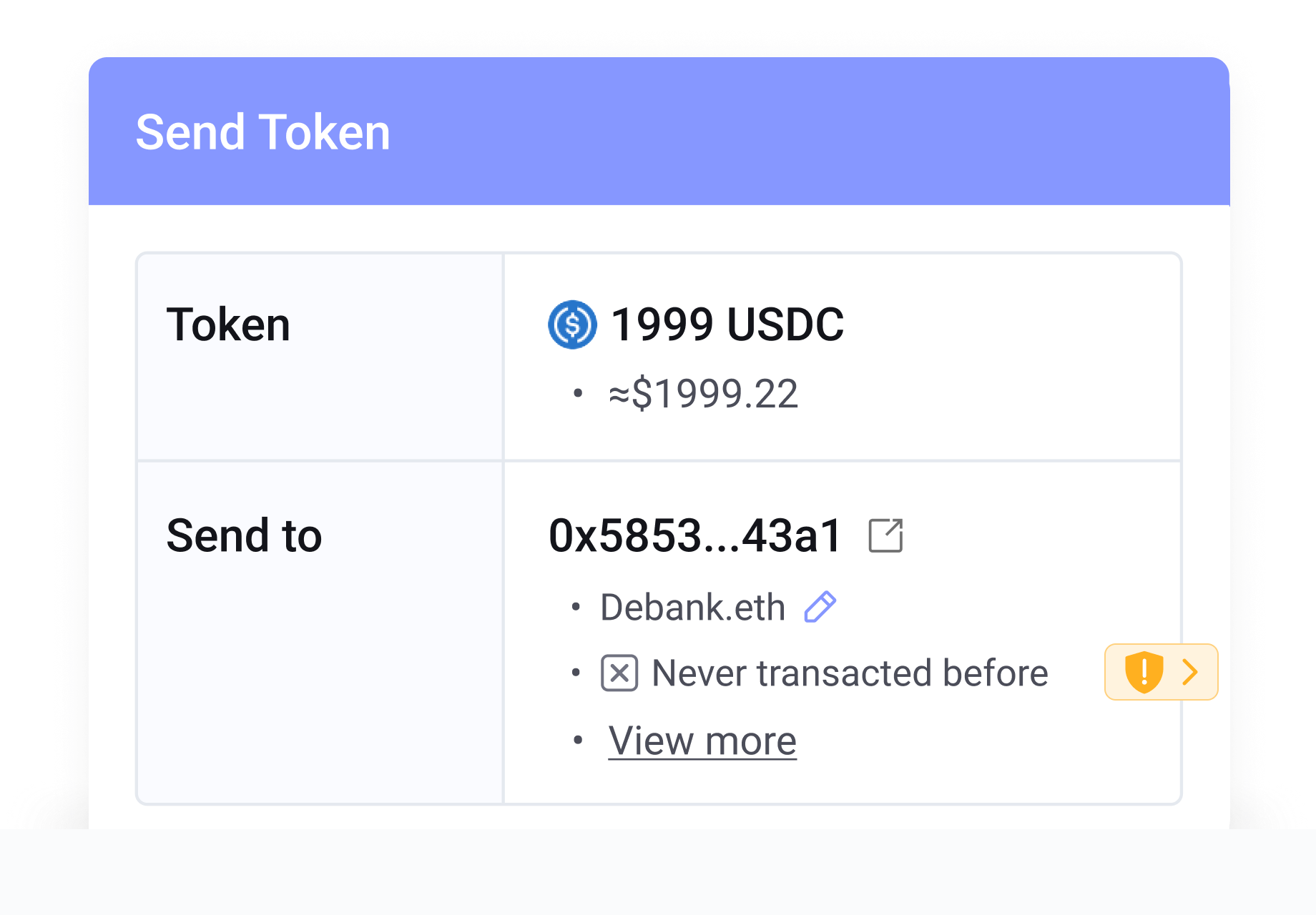
How Rabby’s core safety mechanisms work — mechanism first
Rabby’s defensive posture rests on three tightly related mechanisms: transaction simulation, pre-transaction risk scanning, and approval management. Mechanism means: what code runs before you sign, what signals are derived from that code, and how those signals are presented to you so you can act.
1) Transaction simulation. Before sending a raw signed call to a smart contract, Rabby executes an off-chain simulation of the transaction (using read-only calls to nodes and, where applicable, local EVM replay) to estimate token balance deltas and gas costs. That simulation surfaces exact estimated changes — for example, “You will lose 5,000 USDC and receive 0.48 ETH after fees” — and lets the user spot mismatches between what the dApp UI promised and what the chain call would do. Conceptually, simulation converts a black-box call into a visible state transition that you can audit.
2) Pre-transaction risk scanning. Parallel to simulation, Rabby checks the destination contract and related addresses against internal threat signals: previously hacked contracts, suspicious approval requests, and non-existent recipient addresses. It also looks for unusual patterns like contract bytecode mismatches or recently deployed contracts with high-risk footprints. Alerts have three uses: prompt additional human review, block obviously malicious flows, or suggest preferred mitigations like reducing approval allowances.
3) Approval revocation and session hygiene. Rabby’s revocation tool lists active ERC-20 approvals so you can cancel or tighten allowances without going back into each dApp. This reduces the single largest operational exposure in EVM wallets: perpetual unlimited approvals to exchanges or yield protocols.
Where Rabby fits in a security stack — integrations and practical workflows
Rabby is not trying to be everything. It is a non-custodial, multi-chain wallet built by DeBank that doubles down on front-line transaction safety and operational convenience. For U.S.-based DeFi power users this matters because regulatory and operational exposures push many teams toward layered solutions: local signing with hardware wallets, multi-signature custody for larger treasuries, and enterprise-grade key management for institutional flows.
Practically, Rabby supports hardware wallets (Ledger, Trezor, Keystone, and others), integrates with multi-sig and enterprise providers like Gnosis Safe, Fireblocks, Amber, and Cobo Wallet, and runs as a Chromium extension (Chrome, Brave, Edge), desktop client (Windows, macOS) and mobile app (iOS, Android). That means you can: run Rabby in front of a Gnosis Safe workflow, use it as a signing interface for a hardware device, and still benefit from the same simulation and pre-scan logic before each signature.
If you want to evaluate or obtain the extension: the project publishes downloads and documentation publicly; a convenient starting point is to visit the project page for installation guidance and downloads at rabby.
Notable strengths and the trade-offs they entail
Strength: reduced blind-signing risk. By simulating calls and showing precise token movement, Rabby turns the abstract “approve and swap” sequence into inspectable facts. For traders and arbitrageurs who sign many transactions daily, that can materially reduce losses from phishing dApps or malicious contract upgrades.
Trade-off: simulations are only as accurate as the node, the RPC, and the state snapshot they use. If an RPC returns stale state or if a contract behaves differently when called within the precise sequence of on-chain events, the simulation could diverge from lived reality. Rabby mitigates this with conservative reporting and cross-node reads where feasible, but the fundamental limit remains: simulation reduces, not eliminates, uncertainty.
Strength: institutional and hardware compatibility. Integrations with multi-sig and enterprise key managers let teams slot Rabby into more resilient custody models. For US-based teams that need audit trails and segregation of duties, that’s a real operational gain.
Trade-off: more integration often means a larger surface area for bugs. Past incidents are instructive: in 2022 a Rabby Swap smart contract was exploited for about $190,000. The team froze the contract, compensated users, and increased audits — and this episode illustrates two practical lessons: (a) composability creates extra points of failure (wallet + swap contract + liquidity pool), and (b) open-source code and active incident response reduce but do not erase the residual risk.
Where Rabby breaks or needs work — explicit limitations
Rabby is not an on-ramp solution: it lacks a native fiat gateway to purchase crypto directly with USD. For U.S. users who prefer on-ramp convenience, that means adding a custodial exchange or third-party on-ramp to your workflow — which in turn reintroduces custody-related trade-offs. If you require immediate in-wallet fiat purchases, Rabby will not fulfill that need today.
Rabby also does not provide native in-wallet staking interfaces. If you want one-click staking across chains from the wallet dashboard you’ll need additional tooling. This reflects a deliberate product choice: prioritize secure signing and simulations over bundling many optional DeFi services that add code complexity.
Finally, while Rabby supports 90+ EVM chains and features a cross-chain gas top-up, cross-chain flows remain operationally complex. Gas top-up helps with the immediate problem of not having native gas on a target chain, but cross-chain atomicity and front-running risks require protocol-level solutions (bridges, relayers) beyond a single wallet’s remit.
Decision framework: when to adopt Rabby and when to pair or avoid it
To decide if Rabby fits your profile, use three quick heuristics:
– Frequency and complexity of signing: If you sign high volumes of DeFi transactions, simulation reduces cognitive load and exposure. Adopt Rabby as a front-line signer paired with a hardware device.
– Team custody needs: For treasuries and institutional funds, use Rabby as a signing and inspection layer in front of a multi-sig or enterprise KMS. Don’t rely on it as the sole custody control.
– Feature requirements: If you need fiat on-ramps or native staking dashboards inside a single app, Rabby alone is insufficient today; pair it with custodial services or staking platforms and accept the trade-offs.
Operational checklist for power users installing Rabby (practical steps)
1) Install the extension on a Chromium browser and test in a small-value environment (testnet or tiny mainnet amount). Confirm that transaction simulations and pre-scan alerts appear as expected. 2) Integrate a hardware wallet for signing; never keep significant funds in a seed-only browser wallet. 3) Use the approval revocation tool as routine hygiene after interacting with new dApps. 4) For treasury flows, place Rabby between a secure KMS/multi-sig and the dApp so that each signature benefits from the simulation layer. 5) Maintain conservative allowances and split operations across multiple accounts when possible to reduce blast radius.
What to watch next — conditional signals and forward-looking implications
Two signals will determine whether wallets like Rabby become the de facto safety layer: developer adoption of pre-signing metadata standards (so wallets can simulate more accurately) and cross-wallet interoperability for shared risk signals (e.g., communal blacklists of exploited contracts). If standards evolve to expose richer call semantics to wallets, simulation accuracy will improve and fewer false negatives will occur. Conversely, if dApp UX prioritizes speed and circumvents simulation-friendly APIs, wallets will remain reactive rather than preventive.
Regulatory attention in the U.S. around wallet software tends to focus on consumer protection and AML/CFT when wallets add custodial-like services. Rabby’s non-custodial posture reduces this exposure today, but adding fiat rails or custodial features could change its regulatory envelope. Watch for product changes that bundle fiat or custody to understand new compliance trade-offs.
FAQ
Q: How does Rabby prevent blind signing better than MetaMask?
A: The main difference is the built-in transaction simulation and risk scanning. While MetaMask shows raw call data and lets users approve requests, Rabby simulates the actual balance changes and flags known risks before you sign. That converts an opaque byte-level approval into a readable state transition. However, simulation is not perfect: it relies on RPC state and cannot foresee future on-chain events or reentrancy triggered after your signed transaction is included.
Q: Is Rabby safe enough for a corporate treasury?
A: Rabby provides useful inspection and signing tools and integrates with multi-sig and enterprise KMS providers, which makes it valuable as a front-end signer. For treasury-level custody, Rabby should be paired with multi-sig or an enterprise custody solution (Gnosis Safe, Fireblocks, etc.) rather than used as the sole custody mechanism. Treat Rabby as an operational control that reduces signing risk, not as a primary custodian.
Q: What happened in the 2022 incident and what does it imply?
A: In 2022 a Rabby Swap smart contract was exploited for about $190,000. The team froze the contract, compensated users, and increased security audits. The practical takeaway: composability introduces additional attack surfaces (wallet + swap contracts + liquidity providers). Open-source code and rapid response reduce long-term risk, but they do not make software invulnerable. Continuous auditing and cautious exposure management remain essential.
Q: Can Rabby buy crypto with USD or stake assets directly?
A: Not natively. Rabby currently lacks an in-wallet fiat on-ramp and does not provide its own staking interface. U.S. users who need fiat purchases must use third-party on-ramps or exchanges, and those who want staking will use external protocols or custodial providers. These omissions are trade-offs: fewer integrated features mean a smaller codebase and potentially fewer vulnerabilities, but they require extra tooling in your workflow.
Bottom line for U.S. DeFi power users: Rabby is best treated as a security-fronting signing layer — install it alongside your hardware wallet and multi-sig frameworks to reduce blind-signing risk, use approval revocation aggressively, and accept that some convenience features (fiat on-ramps, native staking) will need external services. Its transaction simulations materially change the quality of the signing decision, but they do not eliminate on-chain uncertainty. If you care about preventing catastrophic operational mistakes rather than simplifying every step, Rabby is worth testing in a staged rollout.